Saturday, June 28th, 2003
The Yellowstone Experience...
I am not religious, but I often say that if there's a God, Yellowstone National Park is evidence
enough that He has not only a sense of humor, but also a rampant imagination. Yellowstone is
perhaps one of the most surreal places on Earth, and as such it is one of my favorite places to go. Its
dynamic nature keeps it in a state of constant change, and in this park... nature will not hesitate to
show you who's boss.
enough that He has not only a sense of humor, but also a rampant imagination. Yellowstone is
perhaps one of the most surreal places on Earth, and as such it is one of my favorite places to go. Its
dynamic nature keeps it in a state of constant change, and in this park... nature will not hesitate to
show you who's boss.
Those who aren't so interested in
Yellowstone are most likely those who merely
drove through it, stopped to see Old Faithful,
and left all in one afternoon... or, those who
haven't been there at all.
Yellowstone is rare. I can't press this
enough. Yellowstone is rare because geysers
are rare. It is also rare because Yellowstone
sits upon a natural hotspot... it's one of the
world's largest active volcanoes, but few
people bother to understand that. Added onto
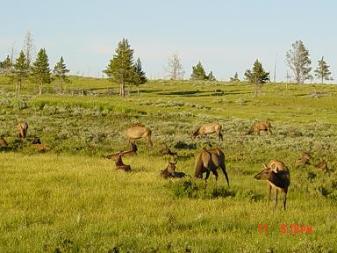
its unique geology is a variety of wild animals,
giant waterfalls, and travertine terraces.
Yellowstone are most likely those who merely
drove through it, stopped to see Old Faithful,
and left all in one afternoon... or, those who
haven't been there at all.
Yellowstone is rare. I can't press this
enough. Yellowstone is rare because geysers
are rare. It is also rare because Yellowstone
sits upon a natural hotspot... it's one of the
world's largest active volcanoes, but few
people bother to understand that. Added onto
its unique geology is a variety of wild animals,
giant waterfalls, and travertine terraces.
Yellowstone is home to more than half of the world's geysers, with around 500 in the records. At
second place is Dolina Geizerov in Russia with about 200.
In definition, geysers are hot springs with pressure-tight plumbing systems that go through cycles of
building pressure, and eruption due to that pressure reaching its breaking point. Volcanoes aren't rare,
and neither are hot springs. What makes a geyser so rare is a mineral called rhyolite, rich in silica (quartz)
that is compounded into geyserite. This geyserite is often what gives hot springs and geysers their distinct,
strangely shaped cones, mounds, or ridges.
second place is Dolina Geizerov in Russia with about 200.
In definition, geysers are hot springs with pressure-tight plumbing systems that go through cycles of
building pressure, and eruption due to that pressure reaching its breaking point. Volcanoes aren't rare,
and neither are hot springs. What makes a geyser so rare is a mineral called rhyolite, rich in silica (quartz)
that is compounded into geyserite. This geyserite is often what gives hot springs and geysers their distinct,
strangely shaped cones, mounds, or ridges.
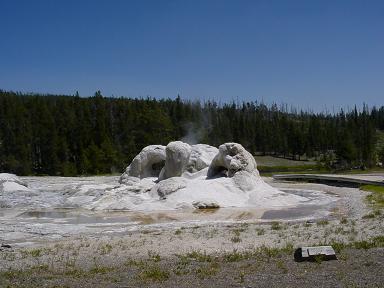
To the right is Grotto Geyser, a
resident of the Upper Geyser Basin. Its
interesting shape is due to years and
years of geyserite forming over tree
stumps. Though Grotto displays the
most interesting outward signs of what
geyserite can do, imagine a plumbing
system with geyserite building onto it.
Eventually, the pipes will form small
reservoirs blocked significantly by
geyserite. However, the pressure from
hot water and steam builds and builds
until the reservoirs can no longer
contain it. The result- a geyser eruption.
resident of the Upper Geyser Basin. Its
interesting shape is due to years and
years of geyserite forming over tree
stumps. Though Grotto displays the
most interesting outward signs of what
geyserite can do, imagine a plumbing
system with geyserite building onto it.
Eventually, the pipes will form small
reservoirs blocked significantly by
geyserite. However, the pressure from
hot water and steam builds and builds
until the reservoirs can no longer
contain it. The result- a geyser eruption.
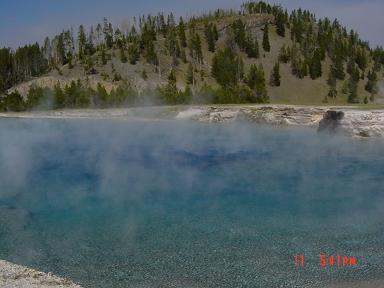
Of course, there are geysers that
eventually blow their plumbing systems
to bits. To the left is the Excelsior
Geyser Crater in the Midway Geyser
Basin. Don't let the photo fool you-
Excelsior is gigantic, and discharges
some 4,050 gallons of water every
minute into the Firehole River. Its
eruptions once reached up to 300 feet,
and it erupted frequently.
Its last great eruption was in 1890,
when its pressure chambers were
wrecked. The overwhelming discharge
is actually its vents "leaking", in other
words, the underground water
reservoirs aren't able
eventually blow their plumbing systems
to bits. To the left is the Excelsior
Geyser Crater in the Midway Geyser
Basin. Don't let the photo fool you-
Excelsior is gigantic, and discharges
some 4,050 gallons of water every
minute into the Firehole River. Its
eruptions once reached up to 300 feet,
and it erupted frequently.
Its last great eruption was in 1890,
when its pressure chambers were
wrecked. The overwhelming discharge
is actually its vents "leaking", in other
words, the underground water
reservoirs aren't able
to build up enough pressure to allow for any serious activity. Nonetheless, I am always awed by
Excelsior. Though no longer a geyser, its boiling surges can reach over six feet in height, and it boils
violently in several places. It is certainly one of the most grand features in Yellowstone.
Excelsior. Though no longer a geyser, its boiling surges can reach over six feet in height, and it boils
violently in several places. It is certainly one of the most grand features in Yellowstone.