Some geysers use nearby hot springs as their water reservoirs. Below is a photo of Steamboat
Geyser, currently the world's tallest active geyser. It's eruptions are inconsistent, but can reach up to
400 feet in height. While I have not been lucky enough to observe Steamboat in one of its full eruptions,
I am told that it is actually a violent, earth-shaking, and exhilerating (if not completely frightening)
display.
Geyser, currently the world's tallest active geyser. It's eruptions are inconsistent, but can reach up to
400 feet in height. While I have not been lucky enough to observe Steamboat in one of its full eruptions,
I am told that it is actually a violent, earth-shaking, and exhilerating (if not completely frightening)
display.
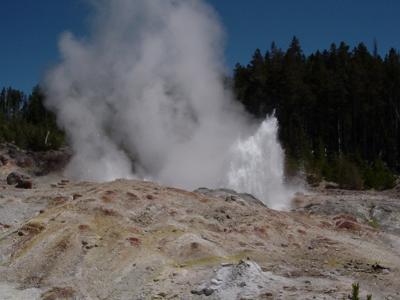
On most occasions, Steamboat
will belch out a ten-foot blast of
water every minute or so. Located
in the Norris Geyser Basin, it is
one of many features that sit atop
Yellowstone's hottest spot.
I mention Steamboat Geyser
because it is one geyser that draws
its water from its neighbor, Cistern
Spring, just a short walk down the
trail. Whenever Steamboat Geyser
has a full eruption, Cistern Spring is
completely drained of its own
water.
will belch out a ten-foot blast of
water every minute or so. Located
in the Norris Geyser Basin, it is
one of many features that sit atop
Yellowstone's hottest spot.
I mention Steamboat Geyser
because it is one geyser that draws
its water from its neighbor, Cistern
Spring, just a short walk down the
trail. Whenever Steamboat Geyser
has a full eruption, Cistern Spring is
completely drained of its own
water.
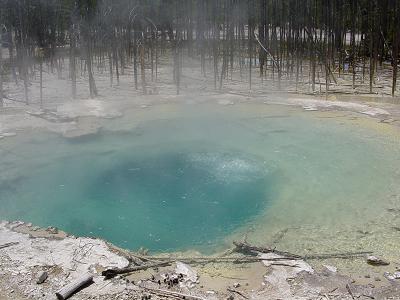
To the right is Cistern Spring. It is
typical for a Yellowstone hot spring,
with a nice blue hue and bubbling
surface. Notice the dead trees
surrounding the boiling spring...
they've been cooked to death. Very
little life can withstand temperatures
around hot springs such as this one.
The blue color indicates that even
heat-loving bacteria, or thermophiles,
cannot survive here. However, hot
springs can be many different colors,
depending on the temperature or each
spring. Typically, the center is the
hottest, but the edges may be cool
enough to support bacteria that
creates varying colors.
typical for a Yellowstone hot spring,
with a nice blue hue and bubbling
surface. Notice the dead trees
surrounding the boiling spring...
they've been cooked to death. Very
little life can withstand temperatures
around hot springs such as this one.
The blue color indicates that even
heat-loving bacteria, or thermophiles,
cannot survive here. However, hot
springs can be many different colors,
depending on the temperature or each
spring. Typically, the center is the
hottest, but the edges may be cool
enough to support bacteria that
creates varying colors.
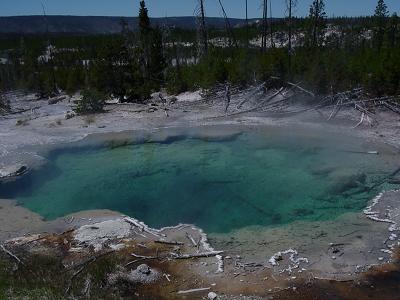
Emereald Spring (left) is also part
of the Norris Geyser Basin. It is a
good example of how its
temperature is related to the color it
gives. Few thermophiles can survive
within it, but its walls are lineed with
yellow sulfur. When seen under the
blue of the sky, it produces a nice
green color.
Not to be confused with Emerald
Pool, which is located in Black Sand
Basin, close to the Old Faithful area.
Emerald Pool gives off a deeper,
richer color of green. Though its
cause is the same- high sulfur content
lining the hot spring walls.
of the Norris Geyser Basin. It is a
good example of how its
temperature is related to the color it
gives. Few thermophiles can survive
within it, but its walls are lineed with
yellow sulfur. When seen under the
blue of the sky, it produces a nice
green color.
Not to be confused with Emerald
Pool, which is located in Black Sand
Basin, close to the Old Faithful area.
Emerald Pool gives off a deeper,
richer color of green. Though its
cause is the same- high sulfur content
lining the hot spring walls.
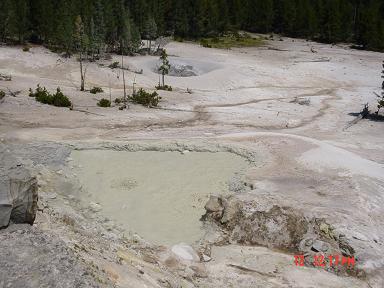
On the subject of sulfur, this element
is found almost everywhere in the park.
The burning sulfur in the hot springs is
what gives off that characteristic odor
of bad eggs throughout the park.
Sulfuric acid is the cause of mudpot
activity. The acid eats away at clay
deposits, and when combined with
underground heat, creates a thick,
bubbling goop that pops as air bubbles
rise to the surface.
To the right is a photograph of
Sulphur Cauldron, located right across
from the Mud Volcano area parking lot.
is found almost everywhere in the park.
The burning sulfur in the hot springs is
what gives off that characteristic odor
of bad eggs throughout the park.
Sulfuric acid is the cause of mudpot
activity. The acid eats away at clay
deposits, and when combined with
underground heat, creates a thick,
bubbling goop that pops as air bubbles
rise to the surface.
To the right is a photograph of
Sulphur Cauldron, located right across
from the Mud Volcano area parking lot.
Its yellowish-brown color is due to the combination of sulfur and mud, and its pH is about 1-2,
making it the most acidic spring in the park. Just for reference, its as acidic as car battery acid or
stomach fluid. Pleasant, eh?
making it the most acidic spring in the park. Just for reference, its as acidic as car battery acid or
stomach fluid. Pleasant, eh?