Habitat: Northern alpine forests, particularly close to lakes and rivers;
Primarily North America and Asia
Body Size: 6-7 feet in length from tip of beak to tip of tail
Wingspan: 14-16 feet across
Average Lifespan: 130 years
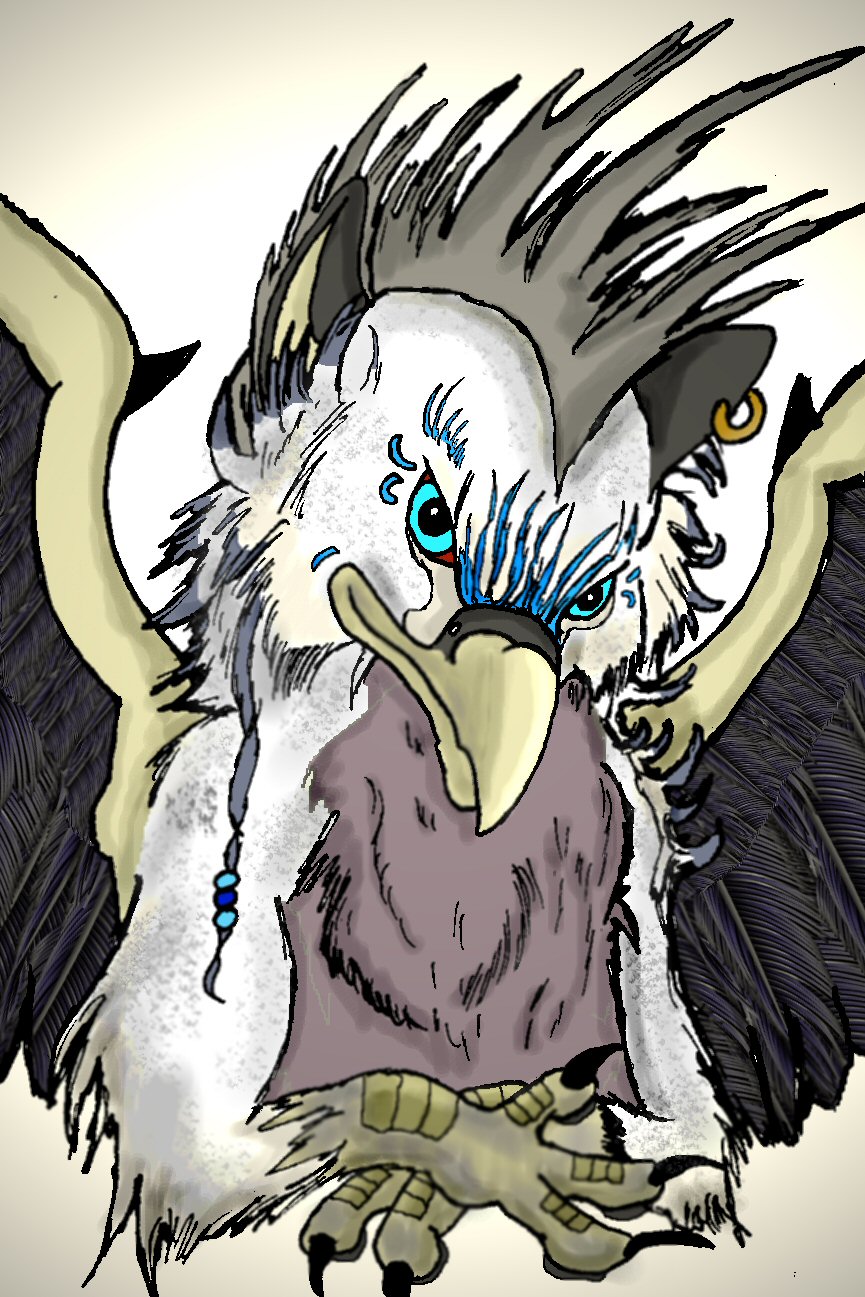
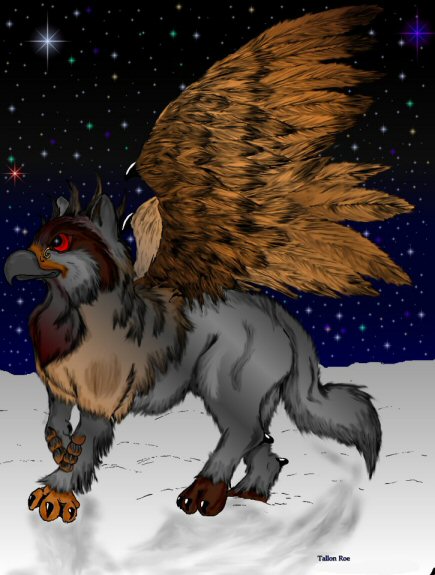
The Northern Lupogryph appears as a curious hybrid of lupine and avian stock. The broad head is characterized by the sharp, curved beak (gray or black in color) and the oversized eyes of a raptor (varying in color from a deep brown, to a brilliant golden amber, to an earthy red; some reportedly have pale blue eyes). The nostrils appear as darkened comma-shaped slits behind the beak. The shorter fur on the head typically clumps together to form a feathery consistency, with a tousled crest of coarse fur extending from the back of the neck to the forehead. The ears, about three inches from base to tip, are erect and triangular in shape with mildly rounded tips.
From the neck, all the way down the wide chest and to the prominent shoulders, the lupogryph’s fur coat becomes thick and wooly, adding a small amount of bulk to the creature’s forefront. The forelegs, below the elbows, are covered in a thin, velvety hair that condenses and feathers around the wrists. The front “paws” have slightly elongated digits in comparison to those of a normal canine, and each digit ends in a blunt but sturdy curved black claw. The bottoms of these appendages are covered in rough and hardened scaly pads- at the base of each digit as well as a larger pad at the palm. The structure and shape of the front paw easily allow for the lupogryph to grab and manipulate simple tools and other objects.
Beyond the shoulders, the body structure of the lupogryph is nearly identical to that of a gray wolf, and the fur coat becomes slightly shorter and softer. The guard hairs on the lupogryph’s coat do not grow around the lower belly, leaving only the soft, downy undercoat to protect it. The hind legs are long and the hind paws are slightly larger than a normal wolf’s paws. The tail, when in a relaxed position, extends down slightly past the creature’s ankles, and is covered in thick, bushy hair.
A lupine gryphon’s wings are perhaps the most important physical characteristic of the creature, allowing it to move with equal ease in the air as on land. The wings are large and broad, covered in layers of soft (almost “fuzzy”) feathers that often have dark tips. The best comparison to the shape of the lupogryph’s wings would be the wings of an osprey. On males, the elbow-like joints of the wings are accompanied by small black, hooked spurs. This feature is perhaps the most noticeable physical distinction between the two genders.
Coloration and patterns of fur and feathers vary from specimen to specimen, although most lupogryphs within a tribe will have a fairly uniform appearance. The northernmost tribes are often snowy-white in color with pale gray highlights and silvery-colored wings, and some of these even have white-blue eyes. Tribes of all-black lupogryphs have been encountered in very dense forests in northern Eurasia. Most lupine gryphons, however, have brownish-gray grizzled coats with dark ears, crests, and wings, as well as a dark umber streak extending from around their eyes to the base of their necks. The occasional albino has also been spotted, though very, very rarely.
The lupine gryphon is not strictly a carnivore, though it often prefers meat to vegetation. The favored meat in a lupogryph’s diet is largely fish in the summer and autumn seasons (when the water is not covered in ice), and the creatures often live near large mountain lakes and rivers for this reason. Lupogryphs mostly use their wings for the purpose of hunting fish, gliding in the air over water in the early morning and late afternoon when fish come close enough to the surface of the water to feed. Upon seeing the silvery form of a fish near the surface, a lupogryph will drop into a graceful dive and use its beak to snag its prospective meal from the water. About thirty percent of attempts are ever successful, and the occasional mistakes happen (resulting in soaking-wet and still very hungry lupogryphs).
In the winter and spring months, lupogryph tribes will follow herds of deer and elk near their home territory. They hunt together as a pack, and their success rate in hunting ungulates is much higher than when they hunt fish on their own. They will hunt once every few days and gorge themselves on a successful kill, given them enough energy to survive with very little nourishment for the next few days until it is time to hunt again.
Lupogryphs are careful about their hunting and try to avoid hunting in another tribe’s territory. Most conflicts between tribes of lupogryphs will involve food in some way. When a herd of elk or deer pass into another’s territory, wiser lupogryphs will stand their ground and hunt smaller creatures until the herds move back into their own lands.
Sitting at the top of the food chain, lupine gryphons rarely have difficulties defending their kills, but the occasional conflicts occur. Scavenging grizzly bears are often a source of such conflicts, and more than one lupogryph has been wounded in a fight before the bear backs down and leaves.
When food is particularly scarce, lupogryphs are rarely picky eaters. Berries, bark, and grasses can all be regarded as food when the pickings are slim. Rodents, small birds, and insects are also considered fair game, though they make for poor nourishment.
For the most part, small caves in cliff-sides overlooking the forest provide ideal homes for adult lupogryphs. These caves will often have more than one entrance and are usually inaccessible to creatures without wings. Lupogryphs will move to underground dens when there are new pups in the tribe or sometimes during the winter months, or even when one member of the tribe is wounded and cannot fly. The creatures dig these underground dens themselves and line the walls with stones and mud for extra stability.
There is a very well-defined social structure among lupogryph tribes, and loners fare badly without the aid of their kin.
Lupine gryphons exist in closely-knit tribes that usually number no more than one dozen adults and adolescents. They hunt together, sleep together, play together, and all have equal responsibility in seeing to the welfare of pups. Each tribe usually looks to a specific mated pair as its leaders, usually the strongest within a tribe. These “alphas” share responsibilities in keeping the tribe in good order: leading hunts, disciplining the young, confronting trespassers and other threats, making patrols around the borders of their territory, and doling out lesser responsibilities to the others in the tribe.
These creatures have a highly developed native language consisting of churrs, growls, whines, barks, hisses, howls, and grunts in conjunction with body language. This is typically how lupogryphs communicate with each other, but they are extremely quick to pick up on the languages of other greater beasts including different species of gryphons. Most lupogryphs learn to understand the human language, though significantly fewer can actually speak it without difficulty. Pack alphas are expected to know and speak the language of nearby humans, as well as have the ability to write. A lupogryph’s writing is a very crude scrawl, and often very blunt and expressionless, since they do not understand how to convey the meanings of their body language into their writing. On the other hand, when communicating in their native language, lupogryphs are very expressive and poetic creatures.
They are avid readers and love good stories, and have a natural curiosity and love for the world around them. Friendly gatherings of lupogryph tribes are celebrated by long hours of singing and storytelling, though to human ears such events sound like nothing more than loud animal noises.
Stories, songs, and poems among lupogryphs most commonly consist of the following topics: hunting, traveling, treasure, love, and the celestial bodies. Lupogryphs are fond of the stars and the moon and are very openly curious about them. Perhaps their love of the stars stems from their love of other glittering things- namely treasure.
Material possessions have great importance among lupogryphs, as most are avid collectors of almost anything- from the finest gold to mere animal bones. Their real material obsession, however, is not silver nor gold. Lupogryphs have an unnatural fascination with glassy objects, which makes them particularly partial to gemstones and crystals. Even broken glass bottles and mirrors have a special place in a lupogryph’s stash, and no den is complete without piles of “treasure”. Given their love for treasures, lupogryphs have strict gift-giving traditions that take place whenever one tribe visits another. An exchange of gifts between the alpha pair of one tribe and the alphas of another is sacred rite of respect and courtesy. Sometimes gifts can consist of food, but books, jewels, and curious remnants of human camp sites are often exchanged as well. Lupogryphs care little about the human-based monetary value of their treasures- they value color and shine in their objects above other traits, and take special interest if there is a particularly fascinating story behind any particular piece of treasure.
Lupogryph tribes will occasionally congregate for more formal reasons than stories and treasure. Territory boundaries are sometimes bartered over, and sometimes alphas even meet to arrange inter-breeding between tribes in order to produce healthy and diverse pups. Tribes avoid fighting with each other, and fights usually only break out when a territory has been trespassed upon for hunting reasons. For the most part, lupogryphs will display a casual respect toward one another and tribes will make their own efforts to avoid stepping on each other’s toes.
Given their respect toward one another, and their strong ties to family, it is no surprise that lupogryphs will often foster lost pups, and will even sometimes care for the misplaced young of other species of gryphons. They also coddle their sick and their old instead of leaving them to die. They have a natural love for their kin, and value family above most everything else, and an entire tribe is considered family.

Lupogryphs prefer to stay in the wilderness away from human settlements, and avoid crossing into human villages and cities if at all possible. Though contact between the two species can and does happen, and when it does, only the alphas make a point of communicating with the humans. Killing a lupogryph is a difficult feat to accomplish with ordinary hunting rifles, but some humans have made the attempt nonetheless. The occasional friendly human will chance upon a tribe and offer books and other curiosities, but even then the two species regard each other with caution. Lupogryphs have found very little to trust in human nature, and like to keep their distance as a result. With such a rapidly expanding population, however, humans are becoming harder to avoid.
Lupogryphs are monogamous, keeping the same mate for life. A lupine gryphon will usually find a mate among a tribe other than its own, and will participate in a series of lengthly courtship rituals (usually involving treasure, singing, and offerings of food) to gain the favor of a prospective partner.
Not all pairs within a tribe are permitted to produce offspring. The alphas choose who will be allowed to have pups each breeding season (which occurs once at the end of winter every ten years) and who won’t. This ensures that each generation is different and that there are not more pups than the tribe can take care of at one time.
The average gestation period of a lupogryph is thirteen months, and the tribe will move into an underground den before the pups arrive.
Pups are born live (instead of hatching from the eggs), though blind and mostly hairless. one to three pups are born per mated pair, though larger litters have been observed. They start growing their coats almost immediately, though they do not gain their vision for another two months. Pups are skinny, awkward, and graceless. They have round bellies, are covered in a coat of downy fuzz, and their ears are often folded down. They cannot fly (hence why they are not born in high caves) until their wings become fully developed at two years of age.
Pups are considered the highest priority in a tribe, and all lupogryphs in a tribe are expected to help watch over, feed, and protect the pups from harm. Pups are fed regurgitated food, and they move on to a regular diet at about one year of age. At two years of age, they begin looking more like the adults and begin to display patterns in their coats. Their bellies are still fairly large, however, and their tails are still skinny. Their wings also become functional, though their ability to fly is still fairly miniscule. At this age, as they get better at flying, they begin the long and frustrating process of learning to hunt.
When the pups are about three years of age, they move with the tribe to the cliff-side den. They will typically not stray far from their parents until they are about ten years of age. They are not considered sub-adults until about the age of twenty, and are considered full adults by the age of thirty.