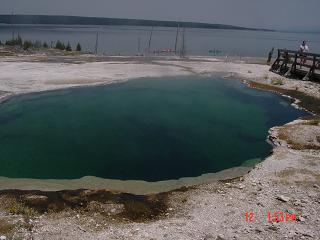
The West Thumb Geyser Basin sits at the
western edge of Yellowstone Lake, and is
technically the most recent of the geothermal areas,
even though it was created 630,000 years ago in a
violent explosion. It is named West Thumb because
of the crater its birth made at the side of the lake,
forming a "thumb" on the side of the lake.
Among the spectacular features here, my
personal favorite is Abyss Pool (photo at left),
once named "Elk Geyser" when it was an active
geyser. Now it's a fairly calm hot spring, and the
deepest in the park at about 53 feet deep.
western edge of Yellowstone Lake, and is
technically the most recent of the geothermal areas,
even though it was created 630,000 years ago in a
violent explosion. It is named West Thumb because
of the crater its birth made at the side of the lake,
forming a "thumb" on the side of the lake.
Among the spectacular features here, my
personal favorite is Abyss Pool (photo at left),
once named "Elk Geyser" when it was an active
geyser. Now it's a fairly calm hot spring, and the
deepest in the park at about 53 feet deep.
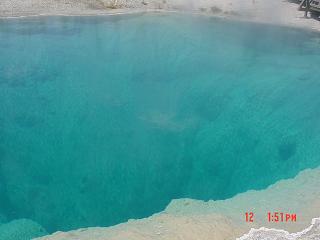
Black pool is on the photo the right. Remember
how I said that the spring temperature affects its
color? You'll notice Black Pool is not black at all.
Before 1991, its water temperature was cool
enough to permit the existence of heat-loving
bacteria. Its temperture rose suddenly in 1991,
killing off the thermophiles which gave it its black
color, and it is now a pure blue.
West Thumb is also home to another famous
Yellowstone feature, one you may have heard
about before: Fishing Cone. Check the photo
below.
how I said that the spring temperature affects its
color? You'll notice Black Pool is not black at all.
Before 1991, its water temperature was cool
enough to permit the existence of heat-loving
bacteria. Its temperture rose suddenly in 1991,
killing off the thermophiles which gave it its black
color, and it is now a pure blue.
West Thumb is also home to another famous
Yellowstone feature, one you may have heard
about before: Fishing Cone. Check the photo
below.
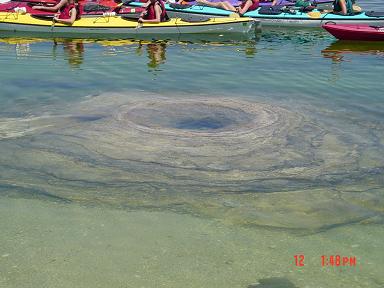
In this photo, Fishing Cone is
submerged by the lake. This happens
seasonally. The reason it became so
famous is because years ago, fishermen
on this lakeshore would reel in their fish
and then dunk it in the water of Fishing
Cone, cooking it right on the line. Of
course, this is no longer allowed due to
injuries sustained from the high
temperature waters. Also, it seems
Fishing Cone's temperature has
decreased significantly. From evidence
of years ago, it is clear tha Fishing
Cone was once much, much hotter.
submerged by the lake. This happens
seasonally. The reason it became so
famous is because years ago, fishermen
on this lakeshore would reel in their fish
and then dunk it in the water of Fishing
Cone, cooking it right on the line. Of
course, this is no longer allowed due to
injuries sustained from the high
temperature waters. Also, it seems
Fishing Cone's temperature has
decreased significantly. From evidence
of years ago, it is clear tha Fishing
Cone was once much, much hotter.
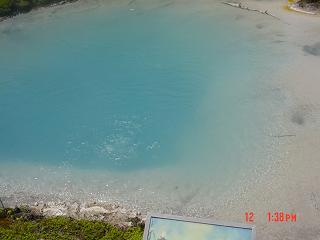
The photo at right is of Seismograph Pool, next
to Bluebell Pool. Prior to 1959, they were named
the "Blue Pools", but were renamed after the
1959 Hebgen Lake earthquake... even though it
seems that nothing about these pools changed as a
result, unlike many features in the park.
I should also note that a startling amount of
injuries and deaths have happened here at West
Thumb from people falling into hot springs and
mud pits. Like Mud Volcano, the land here is
unstable. In fact, when I was there in 2001, a
section of the boardwalk was roped off because
several hotsprings nearby
to Bluebell Pool. Prior to 1959, they were named
the "Blue Pools", but were renamed after the
1959 Hebgen Lake earthquake... even though it
seems that nothing about these pools changed as a
result, unlike many features in the park.
I should also note that a startling amount of
injuries and deaths have happened here at West
Thumb from people falling into hot springs and
mud pits. Like Mud Volcano, the land here is
unstable. In fact, when I was there in 2001, a
section of the boardwalk was roped off because
several hotsprings nearby
were erupting violently and splashing the walkways with boiling water. As I mentioned before, this place
always seems to be changing. When I returned in 2002, the hot springs that had become over-active
had again quieted down.
always seems to be changing. When I returned in 2002, the hot springs that had become over-active
had again quieted down.
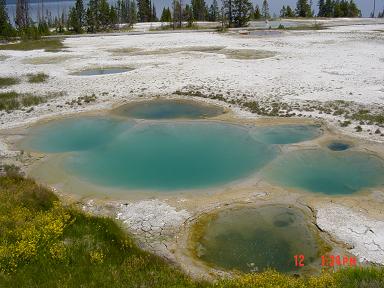
The Central Basin of West Thumb is
the most dynamic of West Thumb's
accessible areas. The photo at left
shows a collection of hot springs
commonly found in this area. Hot
springs like these change consistently,
and in a few years they may no longer
be here, but others will have formed
elsewhere. Notice that the pool at the
bottom center, despite its close
proximity to the others, is significantly
cooler.
There are geysers here in West
Thumb, but not many are regular
players. These inclue Twin Geysers
and Lakeshore Geyser.
the most dynamic of West Thumb's
accessible areas. The photo at left
shows a collection of hot springs
commonly found in this area. Hot
springs like these change consistently,
and in a few years they may no longer
be here, but others will have formed
elsewhere. Notice that the pool at the
bottom center, despite its close
proximity to the others, is significantly
cooler.
There are geysers here in West
Thumb, but not many are regular
players. These inclue Twin Geysers
and Lakeshore Geyser.